
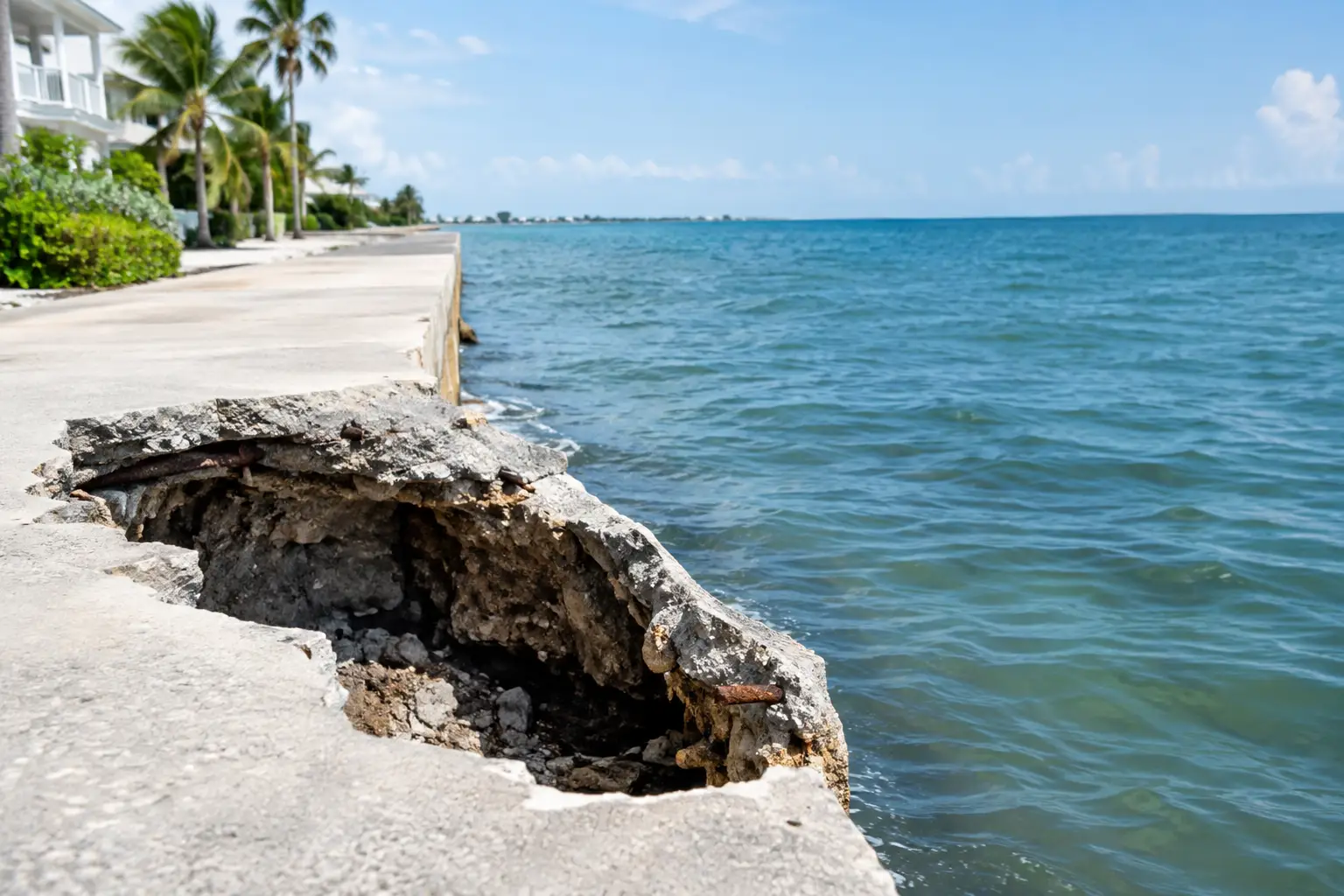
A small depression near a seawall can look harmless after a heavy Florida rain. But when homeowners ask what causes seawall sinkholes, the answer is usually not the rain alone. A sinkhole or settling area beside a seawall often signals that soil is escaping through gaps, cracks, failed joints, or weakened areas behind the wall. Left alone, that hidden soil loss can spread beneath patios, pool decks, walkways, driveways, and even parts of the home.
For waterfront property owners, the key is to treat new settlement as a structural warning, not a landscaping problem. Filling the visible hole may improve the appearance for a while, but it does not stop the path that allowed the soil to wash away in the first place.
What causes seawall sinkholes?
Most seawall sinkholes form when water moves through or around a seawall and carries soil with it. Marine contractors often call this process soil migration or washout. Water finds a route through an opening, pulls fine material into the canal, bay, river, or harbor, and leaves a void behind the wall. As the void grows, the surface soil eventually loses support and drops.
This can happen gradually over years or become noticeable quickly after a storm, a king tide, or a period of heavy rain. The visible hole is often the last stage of a problem that has been developing below ground.
Failed seawall joints and cracks
Concrete seawalls are built in sections. The joints between those sections must remain sealed enough to keep backfill soil where it belongs. As seawalls age, joints can separate, sealant can fail, and cracks can develop from settling, water pressure, impact, or normal material movement.
Once water has an opening, every tidal cycle can move more soil. On a canal-front lot, boat wakes may add repeated pressure changes. On open water, wave action can make the process faster. A narrow crack below the waterline may be enough to create a significant void behind the wall, even if the cap and yard still look relatively sound.
Drainage problems behind the wall
A seawall holds back land, but it is not meant to trap large volumes of water in the soil behind it. Heavy rain, irrigation runoff, downspout discharge, and poor yard grading can saturate the backfill. That added water creates hydrostatic pressure against the wall and seeks the easiest route out.
If drainage features are clogged, missing, or no longer functioning properly, pressure builds. Water can force soil through damaged joints, cracks, weep holes, or weak areas at the base of the wall. This is why a sinkhole that appears after a summer downpour may still be tied to a seawall issue rather than rain alone.
Deteriorated tiebacks or structural movement
Many seawalls rely on tiebacks or anchor systems to resist the force of the retained soil. When those components corrode, weaken, or shift, the wall may begin to lean, separate, or move outward. Even slight movement can open joints and create gaps behind the structure.
Warning signs may include a cap that is cracking, a wall that is no longer straight, gaps between the cap and adjacent deck, or fence posts and pavers that are beginning to tilt toward the water. Structural movement calls for a professional evaluation because filling the void without addressing the cause can add weight to already unstable soil.
Erosion at the toe of the seawall
The toe is the lower portion of the seawall where it meets the waterway bottom. Scour at this location can undermine the wall from the waterside. Strong currents, prop wash, storm surge, wave action, and changing water depths can remove supporting material around the base.
Toe erosion does not always create an obvious hole in the yard immediately. Instead, it can weaken the wall until cracking, leaning, joint separation, and soil loss begin behind it. Waterfront properties exposed to open bay conditions or frequent boat traffic may need closer monitoring than protected canals, though any seawall can develop problems over time.
Aging construction and unsuitable backfill
Older seawalls may have materials or details that no longer perform as intended. Original joint seals, drainage components, and protective coatings have a service life. In some cases, soil placed behind the wall was poorly compacted or contains a high percentage of fine material that is easier for moving water to carry away.
Not every settlement area means the wall is near failure. Florida soils can settle for several reasons, particularly around recently disturbed ground. The concern rises when settlement is occurring close to a seawall, continues after being filled, appears with cracking or leaning, or worsens after changing water conditions.
Signs of a seawall sinkhole before it gets bigger
Early action can protect a much larger area of the property. Homeowners should watch for new low spots along the seawall, soft or spongy ground, cracks in a concrete cap, separating pavers, and soil pulling away from the wall. A gap that opens between a seawall and a patio or pool deck deserves prompt attention.
Other signs are less obvious. Cloudy water near the wall during or after rain can indicate soil is escaping. Small voids near drainage outlets, loose soil around fence posts, or recurring depressions after backfilling are also meaningful clues. If a dock, lift, or nearby retaining feature appears to have shifted, it may point to broader ground movement.
Do not assume a surface repair has solved the issue simply because the hole no longer shows. A void can remain underground and continue expanding. The safest next step is to identify where the soil is leaving and assess the condition of the seawall itself.
Why simply filling the hole rarely works
Adding topsoil, sand, or gravel to a depression restores the surface but does not close the leak path. If water is still moving through a failed joint or crack, it will carry away the new material as well. Repeated filling can become costly, and it may mask the scale of the void beneath a deck or lawn.
A lasting repair typically requires two connected steps: stop the water and soil from moving through the compromised area, then stabilize or replace lost support behind the wall. The right method depends on the wall’s construction, the condition of its joints and panels, the size of the void, water exposure, access, and whether nearby structures are affected.
For some properties, targeted joint sealing and soil stabilization can address the problem with minimal excavation. For others, structural repairs, tieback work, or more extensive restoration may be necessary. A repair-first approach is valuable because full seawall replacement is not automatically the right answer – but neither is a cosmetic patch when the wall is actively moving.
How a professional inspection protects your waterfront property
A useful seawall inspection should look beyond the visible sinkhole. The goal is to determine whether the issue comes from a joint leak, drainage pressure, structural movement, toe erosion, or a combination of causes. The inspection should also consider nearby hardscapes, dock structures, utilities, and the practical access needed to complete repairs without unnecessary disruption.
At Adams Seawall and Foundation Repair, the focus is on identifying the actual source of soil loss and providing an actionable repair plan. That helps property owners make a clear decision based on the wall’s condition, rather than paying for excavation or replacement that may not be needed.
If the ground beside your seawall is settling, keep people, vehicles, and heavy equipment away from the affected area until it is evaluated. Photograph changes, note whether the area worsens after rain or tides, and arrange an inspection before a small void reaches your patio, pool deck, or foundation. A timely repair can preserve the shoreline protection your property depends on while avoiding a far more disruptive project later.