
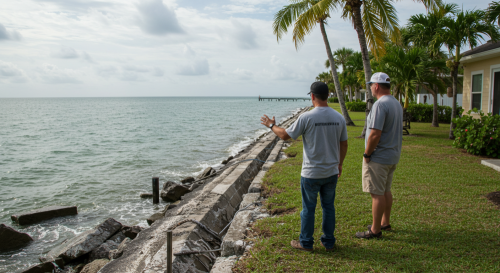
The Hidden Problem Behind Many Seawalls
Most people never think about the condition of their seawall until something goes wrong. Maybe the ground behind it suddenly sinks. Maybe water is leaking through visible cracks. Or maybe, after a big storm, there’s a noticeable tilt. These aren’t just signs of wear and tear, they’re warnings that the very soil holding your seawall up is disappearing.
Erosion, voids, and water intrusion are the silent killers of seawalls. And if you ignore them, you’re not just risking your property. You’re practically handing nature an invitation to collapse your shoreline defenses.
Traditional Seawall Repairs: Expensive, Messy, and Not Long-Lasting
For decades, repairing seawalls meant massive construction crews, heavy equipment, and costly demolition. Often, it required tearing out sections of the existing wall, replacing it with new materials, and hoping the problem didn’t come back a few years later. Even “simple” fixes like pumping concrete into soil voids frequently cracked and failed because they couldn’t flex with tidal movements or withstand ongoing water pressure.
So what’s the smarter, modern alternative? Enter polyurethane foam injection.
What Is Polyurethane Foam Injection?
Polyurethane foam injection is a state-of-the-art repair method that stabilizes soil, fills voids, and reinforces seawall structures, all without ripping your yard apart. It’s minimally invasive, highly effective, and done in a fraction of the time and cost of traditional repair.
Here’s how it works:
Technicians drill small holes into the seawall or soil behind it. Then they inject a specialized polyurethane foam deep underground. The foam starts as a liquid, then expands rapidly when it comes in contact with water or air. As it expands, it seeks out and fills voids, cracks, and weakened soil pockets. Once it cures, it becomes an ultra-dense, water-resistant barrier that bonds the soil together and reinforces the entire structure.
Think of it as giving your seawall a solid, waterproof foundation from below, without digging anything up.
The Science Behind the Foam
Not all polyurethane foams are created equal. The formulas used for seawall repair, like AP Fill 700 or 720, are designed to meet the unique challenges of marine environments. These foams:
- Expand aggressively to fill every gap
- Cure in minutes
- Are fully hydrophobic (they repel water completely)
- Remain stable for decades under heavy loads and moisture exposure
That last point matters. One of the main reasons seawalls fail is because water gets into places it shouldn’t. Polyurethane seals off these weaknesses permanently, creating a tight bond with surrounding soils.
According to a study by IFREMER, polyurethane materials used in marine environments can last over 20 years without significant degradation. That’s real peace of mind.
Why Soil Stabilization Matters
Let’s zoom out a bit. Seawalls don’t fail because the concrete itself breaks down. They fail because the ground supporting them gives way. Once the soil erodes, the seawall loses its base of support and begins to crack, lean, or collapse. That’s why polyurethane foam injection doesn’t just repair the wall, it reinforces the ground it’s built on.
This is known as soil stabilization. When the foam expands into loose or hollow areas, it compacts and strengthens the surrounding material. Over time, this prevents further erosion, keeps the wall in place, and supports any structures built nearby, like patios, docks, or driveways.
As noted by NCFIGEO, this horizontal and vertical injection approach forms a dense underground layer that locks soil in place and stops water from finding new paths.
Case Study: How Polyurethane Foam Saved a Florida Seawall
Florida homeowners know a thing or two about seawall damage. Between rising tides, heavy rain, and sandy soils, seawalls down there take a beating. In one recent case shared by Profoam, a waterfront homeowner in Florida had noticed alarming sinkholes behind their seawall.
Instead of tearing the wall out, they chose a professional foam injection team. Within hours, technicians had located the voids, sealed cracks, and restored the structural integrity of the wall using Terra-Lok foam. No demolition. No mess. Just solid results.
The outcome?
- Sinkholes stopped forming
- Seawall cracking ceased
- Property value stayed intact
That’s the power of modern materials meeting smart repair methods.
Waterproofing Where It Counts
Another underappreciated advantage of polyurethane is its natural resistance to water. Some materials absorb moisture over time, becoming heavy, weak, and prone to failure. Not polyurethane. It’s built for wet conditions.
That’s why companies like Prime Resins use products like Prime Flex 920 for seawall repair. This foam is low-viscosity (meaning it flows easily into tight cracks) and water-reactive, it actually needs moisture to cure. That makes it perfect for marine settings, lakefronts, and tidal zones where traditional repairs would struggle to stay in place.
The foam bonds with soil, seals off water pathways, and creates a long-lasting, flexible cushion that won’t crack or shift with changing temperatures or tidal cycles.
Quick Set Time, Lasting Results
Speed matters, especially when your property is under threat. One of the standout features of polyurethane injection is how fast it works. Once injected, the foam expands and cures in just minutes. That means technicians can complete most repairs in a single day.
This fast set time also reduces the risk of environmental disruption. Traditional repair methods can involve days of digging, noise, and machinery. Polyurethane injection, on the other hand, uses a small crew, minimal tools, and precise targeting. In many cases, homeowners don’t even need to leave the property.
More importantly, the foam doesn’t shrink over time. Once it’s in place, it stays there, holding up the soil, supporting the structure, and blocking water.
Environmentally Friendly and Safe for Waterfront Use
Despite being synthetic, polyurethane foams used in seawall repair are engineered for eco-safety. Many are certified safe for use near potable water and don’t leach harmful chemicals into the surrounding environment. That’s a critical concern when working around lakes, canals, and wetlands.
Foremost Foundations points out that polyurethane’s sustainability comes from its efficiency. Because it lasts so long and requires no demolition, it significantly reduces the material waste, fossil fuel use, and ecosystem disruption that other methods cause.
Signs Your Seawall May Be Failing
If you’re standing on your backyard seawall and thinking, “Well, it’s still upright,” that’s not a great metric. Seawalls rarely collapse overnight. They wear down slowly, and the signs are there if you know where to look.
Here’s what to keep an eye out for:
- Soil loss behind the wall – If the ground seems to be sinking or pulling away from the seawall, there’s probably a void underneath.
- Visible cracks or shifting panels – Concrete or wood panels that are leaning, bowing, or separating indicate structural stress.
- Water leaks during high tide – Water trickling through the wall, especially at seams or joints, points to internal erosion.
- Sinkholes or depressions – Sudden dips in your yard or around walkways are telltale signs of erosion below the surface.
- Rust or corrosion on wall anchors – If the seawall is supported with tiebacks or rods, corrosion can compromise their strength.
The good news? All of these issues can be addressed with polyurethane foam injection, before you’re forced into a complete rebuild.
How Polyurethane Foam Works Its Way Into the Problem
Let’s break it down. The beauty of polyurethane foam lies in its ability to move through the soil like water but cure like concrete. When injected under pressure, the foam:
- Seeks out the path of least resistance – This leads it into empty spaces, cracks, and loose soil.
- Expands quickly upon contact with water or air – Creating a dense, closed-cell structure that pushes soil back into place.
- Cures in under 15 minutes – Forming a watertight, load-bearing layer beneath the seawall.
This method effectively restores lost soil volume and compresses loose material, creating a compact foundation that keeps the seawall from shifting or sagging.
In a recent repair in Lake Park, FL, Prime Resins used their proprietary Prime Flex 920 foam to fill underground voids caused by years of tidal seepage. Within hours, the leaking stopped, the wall stabilized, and the homeowner avoided tens of thousands of dollars in reconstruction costs.
Cost Comparison: Foam Injection vs. Traditional Repair
Let’s talk dollars.
Traditional seawall replacement can cost anywhere between $400 to $800 per linear foot, depending on location and materials. For a 60-foot wall, that’s easily over $30,000, not including permits, landscaping repair, or time off work while the backyard turns into a construction zone.
Polyurethane foam injection? It typically lands between $100 to $250 per linear foot, with most jobs completed in one day or less. And since the original seawall stays intact, you avoid added expenses from demolition or replacement materials.
Even better, it’s often considered preventative maintenance, which can help maintain property value and reduce insurance headaches.
If you’re considering this type of repair in Florida, check out how Adams Seawall Repair approaches polyurethane injection and structural stabilization. Their projects often focus on minimal disruption, maximum efficiency, and high-performance results.
Long-Term Durability in Harsh Marine Environments
You might be thinking, “Sure, it works now. But what about in five or ten years?”
That’s the kicker, polyurethane foam is built to last. While traditional grout and fill materials can degrade, shrink, or crack under constant exposure to saltwater and shifting soils, high-density foam remains stable and flexible.
In fact, research by IFREMER concluded that marine-grade polyurethane foam exhibits no significant breakdown for over 20 years in active saltwater environments. That means once it’s injected, you can consider the problem solved for the long haul.
It also resists:
- Freeze-thaw cycles
- Saltwater corrosion
- UV exposure and oxygen breakdown
- Rodent and root intrusion
Because of this resilience, foam injection isn’t just a fix, it’s an upgrade. It turns a failing wall into a reinforced structure ready to take on the next decade of storms.
Versatility Across Seawall Types
One of the major strengths of polyurethane foam injection is how adaptable it is. It’s not limited to concrete seawalls. This method can be used on:
- Wooden bulkheads – Common in older waterfront homes
- Steel sheet piling walls – Often used in commercial or industrial zones
- Vinyl and composite walls – Frequently found in newer developments
- Rock revetments or rip-rap – Foam can fill voids behind or beneath loose rock barriers
Whether your property sits along a freshwater lake, brackish canal, or full oceanfront, polyurethane adapts to the job. It bonds with surrounding materials, expands evenly, and holds up against hydrostatic pressure, making it ideal for the unpredictable conditions of coastal living.
Fast Fixes, Minimal Disruption
Let’s face it: nobody wants a backhoe parked in their yard for two weeks.
That’s another reason polyurethane foam injection is gaining popularity with homeowners and contractors alike. The equipment is small and mobile. The crew is usually in and out within a single day. And when they leave, your yard looks almost untouched.
Here’s how the process plays out:
- A few small holes (around 5/8″ diameter) are drilled into the soil or seawall.
- Injection tubes deliver the foam deep into the affected zones.
- As the foam expands and hardens, soil is compressed and stabilized.
- Holes are patched, cleaned up, and the area is walkable within hours.
Compare that with jackhammers, excavators, and weeks of noise and dust from a traditional rebuild, and it’s easy to see why this method is preferred.
Polyurethane: The Eco-Conscious Choice
One of the most overlooked benefits of foam injection is its environmental friendliness. Companies like Adams Seawall Repair highlight how minimally invasive the process is compared to conventional excavation. Fewer trucks. Less material waste. And zero harm to surrounding vegetation or aquatic life.
The foam itself is inert once cured, it won’t leach toxins or harm the surrounding ecosystem. Many products, including those used by Alchemy-Spetec, are tested and approved for use near potable water sources.
This means no disruption to marine habitats, fish, or native plants. And if you live in a community with strict environmental ordinances or HOA rules, polyurethane injection is often the only repair method that checks all the boxes.
Coming Up in Section 3:
In the final section, we’ll explore the injection process step-by-step, cover best practices for choosing the right contractor, debunk common myths, and show how seawall foam repair plays a key role in protecting waterfront property value.
Step-by-Step: How the Foam Injection Process Works
Let’s pull back the curtain and look at the actual process. One reason polyurethane foam injection is so effective is because it’s not guesswork, it’s a methodical, engineered approach.
Here’s what typically happens when you hire a professional crew:
1. Inspection and Site Assessment
A qualified technician inspects your seawall, looking for signs of soil loss, cracks, water leaks, or shifting. They may use ground-penetrating radar, soil probes, or thermal imaging to map voids and weak zones behind the wall.
2. Drill Injection Ports
Small holes, usually about ⅝” wide, are drilled through the seawall or soil at strategic intervals. These ports allow technicians to reach the problem areas without large-scale excavation.
3. Polyurethane Injection
Using precise pressure and volume controls, the team injects a fast-expanding, water-reactive foam through the ports. The foam spreads laterally and vertically, filling empty spaces, compacting loose soil, and sealing leaks.
4. Curing and Monitoring
The foam cures in minutes. As it hardens, technicians monitor the ground level and wall structure to ensure proper lift and stabilization. If needed, multiple lifts can be done in layers for deep voids.
5. Patch and Clean Up
Once stabilized, the injection ports are sealed, the worksite is cleaned, and the area is ready for use, often the same day.
This isn’t just “spray and pray.” It’s targeted, science-backed structural reinforcement done without destroying your landscaping or access.

Debunking Myths About Polyurethane Seawall Repair
Despite its growing popularity, foam injection still carries some misconceptions. Let’s clear a few of them up:
❌ Myth #1: “Foam breaks down in water over time.”
False. Polyurethane foams used in seawall repair are closed-cell and hydrophobic. They’re engineered to resist water intrusion and last for decades. Research by IFREMER confirms their durability in marine environments exceeds 20 years.
❌ Myth #2: “It’s just a temporary fix.”
Not true. When done properly by experienced professionals, foam injection is a permanent structural solution. It addresses the root cause (soil erosion), not just the symptoms.
❌ Myth #3: “It’s only for small cracks or problems.”
Wrong again. Polyurethane injection is highly scalable. It’s been used in large-scale commercial bulkhead restorations, canal systems, and even entire lakefront communities.
FAQs
What is polyurethane foam injection for seawalls?
It’s a repair method that involves injecting expanding foam into the soil behind a seawall to fill voids, seal cracks, and stop erosion without demolition.
How long does polyurethane foam last in marine environments?
Research shows that high-quality marine-grade polyurethane can last over 20 years without significant breakdown, even in saltwater conditions.
Is polyurethane foam safe for use near water?
Yes. Most repair-grade foams are hydrophobic, inert when cured, and certified safe for use near potable water sources and marine habitats
How much does polyurethane foam seawall repair cost?
On average, costs range from $100 to $250 per linear foot — significantly less than full seawall replacement, which can exceed $800 per foot.
Does this method work on older seawalls or only newer ones?
Foam injection is versatile and works on all types of seawalls, including concrete, wood, steel, vinyl, and composite structures, old or new.
Choosing the Right Contractor
Not all seawall repair companies are created equal. Some slap foam into a wall and call it a day. Others, like Adams Seawall Repair, take a systems-based approach, analyzing the causes of failure, using the correct foam for the environment, and documenting the process with before-and-after metrics.
Here’s what to look for in a foam injection contractor:
- Experience with marine applications (not just foundation repair)
- Use of certified, environmentally safe foam products
- Willingness to explain their process and answer your questions
- Transparent pricing and warranty options
- References or reviews from other waterfront property owners
Also, check if they offer ongoing monitoring or follow-up visits, a sign that they care about long-term results, not just the invoice.
Protecting Property Value and Avoiding Catastrophe
Your seawall isn’t just a piece of concrete, it’s a barrier between your property and potentially thousands of gallons of moving water. If it fails, the consequences are real: flooding, erosion, sinkholes, foundation damage, and the loss of usable land.
Injecting polyurethane foam before a full collapse isn’t just smart. It’s proactive. It protects your:
- Home’s foundation
- Outdoor structures (like patios, docks, and pools)
- Insurance rating and claim eligibility
- Resale value
Buyers today are savvy. Many will walk away from a waterfront property with visible seawall issues. But show them a professionally documented foam repair and a stable shoreline? That’s a selling point.
Real Results Across the Country
In places like Florida, Texas, and Louisiana, where waterfront living is common, polyurethane injection has become the go-to method. It’s used for:
- Residential canal seawalls
- Commercial marinas
- City infrastructure like docks and bridges
- HOA communities protecting retention ponds
And it’s not just in saltwater. Foam injection is also perfect for lakes, rivers, and retention ponds, anywhere erosion and water pressure threaten your ground stability.
Companies like Seawall Repair Network have documented widespread success stories, proving that this method is more than just hype. It’s a real solution backed by data and case studies.
Final Thoughts: Don’t Wait for Disaster
If you’ve noticed soft spots in your yard, water where it shouldn’t be, or signs of soil pulling away from your seawall, now’s the time to act.
Polyurethane foam injection isn’t just a quick fix. It’s a forward-thinking, cost-effective, and environmentally responsible way to restore your seawall, protect your home, and gain long-term peace of mind.
Before you spend tens of thousands on replacement or live in fear of the next big storm, schedule a consultation. Let a pro inspect the damage. Ask about polyurethane. Then decide what’s best for your property and your budget.
Because when it comes to waterfront living, the foundation beneath your feet is everything. Need Help With Your Seawall Repair in Florida?
Visit Adams Seawall Repair to learn more about professional polyurethane injection services and get your shoreline secured, the smart way.